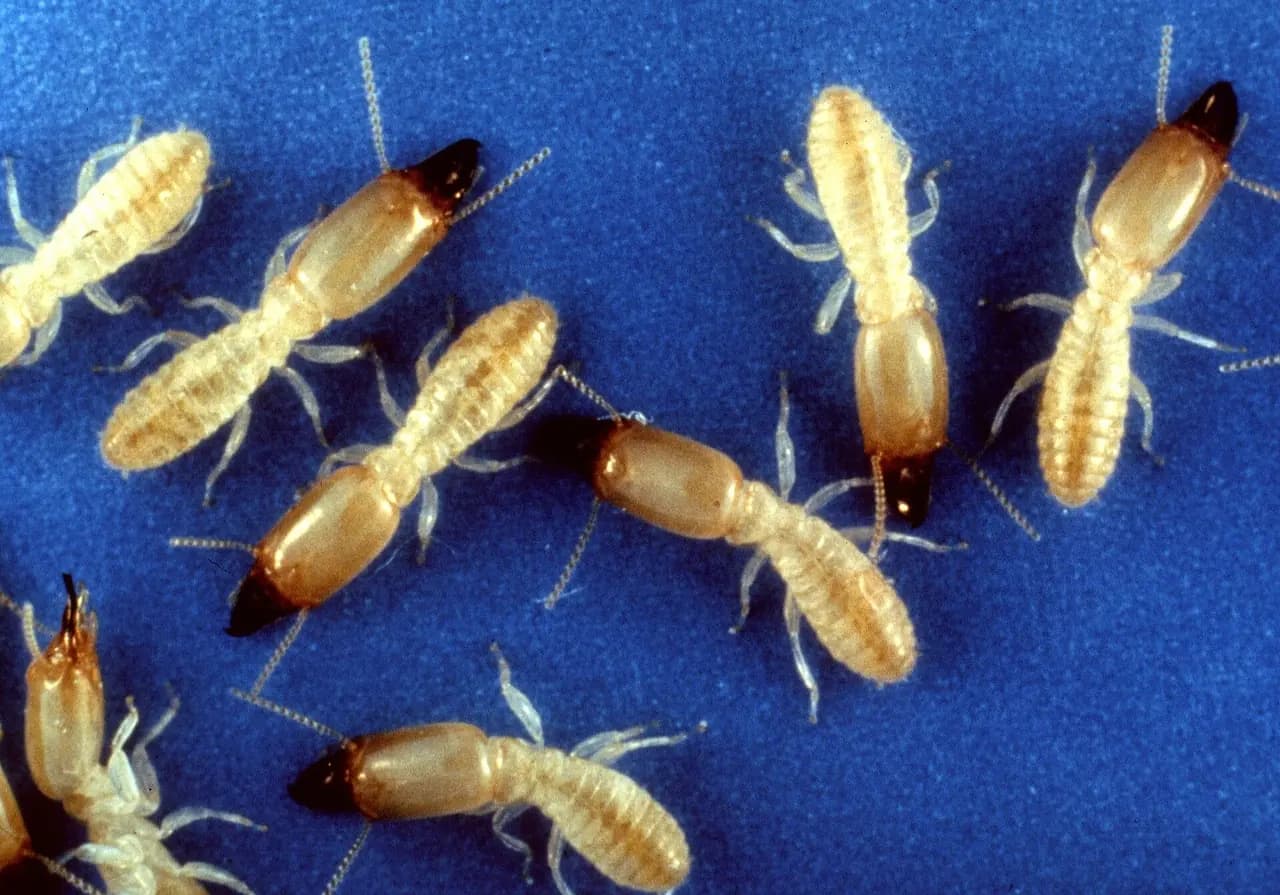
Photo: USDA Agricultural Research Service, Public domain, via Wikimedia Commons
Kansas City Pest Identification
Reticulitermes flavipes (eastern subterranean termite)Subterranean Termite Identification
The termite species responsible for essentially all structural termite damage in the Kansas City area. Colonies live in the soil and build mud tubes to reach wood, working silently for years before damage is visible.
Need help identifying subterranean termite?
Text a photo for fast pest identification. You'll get a real answer from a local expert — not a call center.
How to Identify It
Workers are small, creamy-white, and soft-bodied, found inside damaged wood or mud tubes — not out in the open. Mud tubes are pencil-width, dirt-colored tunnels running up foundations, piers, or interior walls. Damaged wood sounds hollow and often has a honeycomb pattern packed with mud when opened.
Size: Workers 3–4 mm
Commonly Confused With
Carpenter ants (clean, sawdust-like frass, no mud; smooth wood galleries) and moisture-damaged wood with no insect activity at all. Termite swarmers have straight antennae, a thick waist and equal-length wings; carpenter ant swarmers have elbowed antennae, a pinched waist and a longer front wing pair.
Why It Shows Up
The colony lives in the soil, not the house. Workers build mud tubes to bridge the gap between soil and wood, entering through foundation cracks, expansion joints, and anywhere wood contacts soil directly (deck posts, porch steps, fence lines touching the house).
Where Homeowners Find It
Mud tubes on foundation walls (inside crawlspaces and basements, and outside at the slab edge), around plumbing penetrations, behind baseboards near exterior walls, in crawlspace support posts, and at the base of deck ledgers and porch columns.
Seasonal Activity in KC
Feeding and mud-tube building happen year-round underground; swarms of winged reproductives typically occur on warm, humid days in spring (March–May) as colonies mature and send out new queens.
Risk Level
Purely structural — termites don't bite or spread disease, but an untreated colony can do serious damage to sills, joists, and subflooring over several years, and most homeowners insurance excludes termite damage entirely.
What You Can Do Yourself
- • Keep mulch and soil at least 6 inches below siding and away from direct wood contact.
- • Fix downspouts and grading so water doesn't pool against the foundation — termites need moisture.
- • Have any suspicious mud tubes or wood damage inspected before assuming it's something else.
What Professional Treatment Involves
A full inspection to confirm activity and map the extent, then a liquid termiticide (Termidor) applied as a continuous treated zone around and under the structure. All Star backs full treatments with a 5-year retreatment warranty.
The All Star difference: We inspect and diagnose before recommending treatment — ants, moisture damage, and old inactive tubes all get mistaken for active termites, and we'll tell you honestly which one you have.
Serving the Kansas City metro area-wide. Owner-operated with 30+ years of professional pest control experience. See our subterranean termite control service →
Common Questions
How do I tell a subterranean termite from something that looks similar?
Carpenter ants (clean, sawdust-like frass, no mud; smooth wood galleries) and moisture-damaged wood with no insect activity at all. Termite swarmers have straight antennae, a thick waist and equal-length wings; carpenter ant swarmers have elbowed antennae, a pinched waist and a longer front wing pair.
Do I need professional treatment for subterranean termite?
A full inspection to confirm activity and map the extent, then a liquid termiticide (Termidor) applied as a continuous treated zone around and under the structure. All Star backs full treatments with a 5-year retreatment warranty.