
Kansas City Field Guide · 2026 Edition
Pest Identification Charts
Ten free, printable charts built for Kansas City homes. Each one covers the species we see here, the signs to look for, when they are active, and what to do next. Save them to your phone, print them for the garage, or text us a photo and we will identify it for you.
Kansas City species only
Every chart lists the pests we actually find on KC routes — no fire ants, drywood termites or west-coast ticks.
Activity calendars
Month-by-month strips show when each pest is active and peaking in the metro so you know what to expect.
Signs and next steps
What the evidence looks like, what you can handle yourself, and when to text us a photo for a free ID.
Print or save
Letter-size PDF for the fridge or the shop, and a high-resolution PNG you can save to your phone.
Ant Identification Chart
Chart 01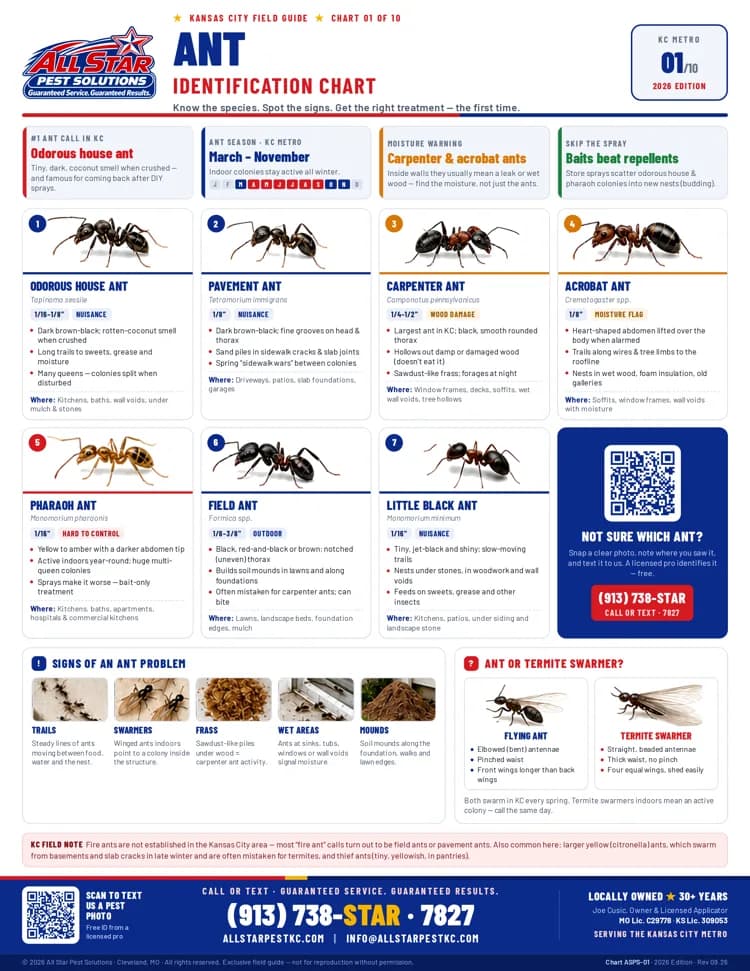
Seven ants account for most Kansas City ant calls. Ant season in the metro runs March through November, though colonies nesting inside a heated building stay active all winter. Odorous house ants are the most common call; carpenter and acrobat ants inside walls usually point to a moisture problem.
| Pest | Size | How to identify it | Where you find it |
|---|---|---|---|
| Odorous house antTapinoma sessile | 1/16–1/8" | Dark brown-black; smells like rotten coconut when crushed; long trails to sweets, grease and moisture; many queens, so colonies split when disturbed. | Kitchens, baths, wall voids, under mulch and stones |
| Pavement antTetramorium immigrans | 1/8" | Dark brown-black with fine grooves on the head and thorax; sand piles in sidewalk cracks and slab joints; spring 'sidewalk wars' between colonies. | Driveways, patios, slab foundations, garages |
| Carpenter antCamponotus pennsylvanicus | 1/4–1/2" | Largest ant in Kansas City; black with an evenly rounded thorax; hollows out damp or damaged wood but does not eat it; leaves sawdust-like frass; forages at night. | Window frames, decks, soffits, wet wall voids, tree hollows |
| Acrobat antCrematogaster spp. | 1/8" | Heart-shaped abdomen held up over the body when alarmed; trails along wires and tree limbs to the roofline. | Soffits, window frames, wall voids with moisture, wet wood and foam insulation |
| Pharaoh antMonomorium pharaonis | 1/16" | Yellow to amber with a darker abdomen tip; active indoors year-round; very large colonies with many queens that split (bud) when sprayed. | Kitchens, baths, apartments, hospitals and commercial kitchens |
| Field antFormica spp. | 1/8–3/8" | Black, red-and-black or brown with an uneven (notched) thorax profile; builds soil mounds; often mistaken for carpenter ants; can bite. | Lawns, landscape beds, foundation edges, mulch |
| Little black antMonomorium minimum | 1/16" | Tiny, jet-black and shiny; slow-moving trails; feeds on sweets, grease and other insects. | Kitchens, patios, under siding and landscape stone |
Flying ant or termite swarmer?
Flying ant
- Elbowed (bent) antennae
- Pinched, narrow waist
- Front wings longer than the back wings
Termite swarmer
- Straight, beaded antennae
- Thick waist with no pinch
- Four wings of equal length that break off easily
Both swarm in Kansas City every spring. Termite swarmers indoors mean an active colony in or under the structure.
Signs of an ant problem
- Trails
- Steady lines of ants moving between food, water and the nest.
- Swarmers
- Winged ants indoors point to a colony inside the structure.
- Frass
- Sawdust-like piles under wood mean carpenter ant activity.
- Wet areas
- Ants at sinks, tubs, windows or wall voids signal moisture.
- Mounds
- Soil mounds along the foundation, walks and lawn edges.
KC field note: Fire ants are not established in the Kansas City area — most 'fire ant' calls turn out to be field ants or pavement ants. Larger yellow (citronella) ants that swarm from basements and slab cracks in late winter are often mistaken for termites.
Spider Identification Chart
Chart 02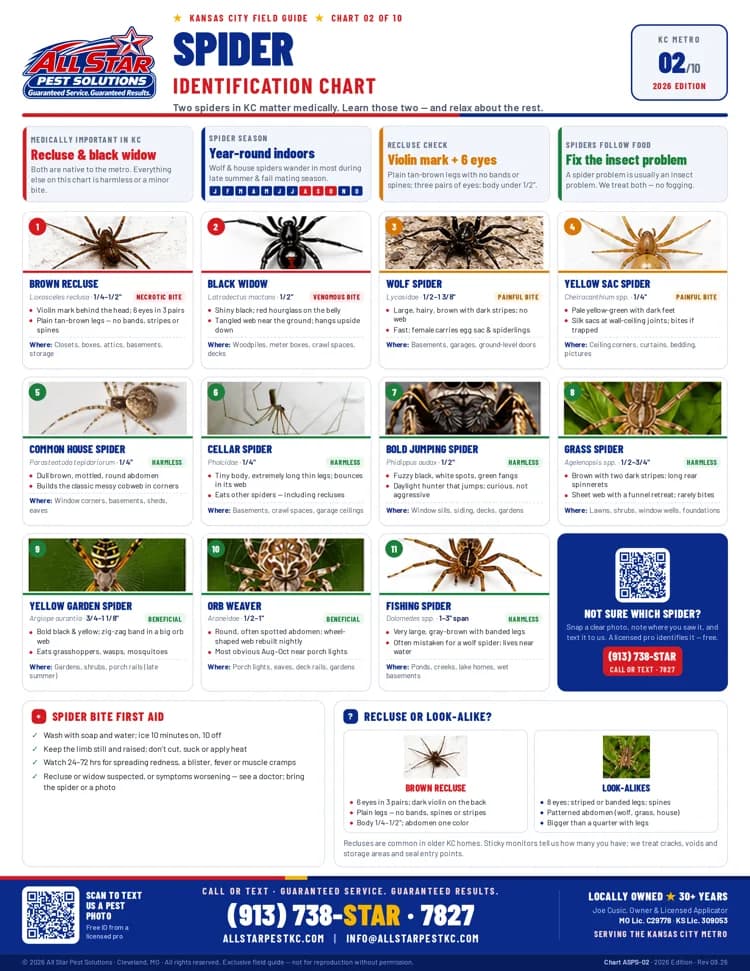
Two spiders in Kansas City matter medically: the brown recluse and the black widow. Both are native to the metro. Wolf spiders and yellow sac spiders can give a painful bite; the rest of the spiders on this chart are harmless or beneficial. Spiders are found indoors year-round, with wolf and house spiders wandering in most during late-summer and fall mating season.
| Pest | Size | How to identify it | Where you find it |
|---|---|---|---|
| Brown recluse (medically important)Loxosceles reclusa | 1/4–1/2" | Dark violin mark behind the head; six eyes in three pairs; plain tan-brown legs with no bands, stripes or spines; abdomen one even color. | Closets, boxes, attics, basements, storage |
| Black widow (medically important)Latrodectus mactans | 1/2" | Shiny black female with a red hourglass on the belly; tangled web near the ground; hangs upside down. | Woodpiles, meter boxes, crawl spaces, decks |
| Wolf spider (painful bite)Lycosidae | 1/2–1 3/8" | Large, hairy and brown with dark stripes; no web; fast runner; female carries her egg sac and spiderlings. | Basements, garages, ground-level doors |
| Yellow sac spider (painful bite)Cheiracanthium spp. | 1/4" | Pale yellow-green with dark feet; silk sacs at wall-ceiling joints; bites if trapped against skin. | Ceiling corners, curtains, bedding, pictures |
| Common house spiderParasteatoda tepidariorum | 1/4" | Dull brown and mottled with a round abdomen; builds the classic messy cobweb in corners. | Window corners, basements, sheds, eaves |
| Cellar spiderPholcidae | 1/4" | Tiny body on extremely long, thin legs; bounces in its web when disturbed; eats other spiders, including recluses. | Basements, crawl spaces, garage ceilings |
| Bold jumping spiderPhidippus audax | 1/2" | Fuzzy black with white spots and iridescent green fangs; hunts by day and jumps; curious, not aggressive. | Window sills, siding, decks, gardens |
| Grass spiderAgelenopsis spp. | 1/2–3/4" | Brown with two dark stripes and long rear spinnerets; flat sheet web with a funnel retreat; rarely bites. | Lawns, shrubs, window wells, foundations |
| Yellow garden spiderArgiope aurantia | 3/4–1 1/8" | Bold black and yellow; zig-zag silk band in a large orb web; eats grasshoppers, wasps and mosquitoes. | Gardens, shrubs, porch rails (late summer) |
| Orb weaverAraneidae | 1/2–1" | Round, often spotted abdomen; wheel-shaped web rebuilt nightly; most noticeable August through October near porch lights. | Porch lights, eaves, deck rails, gardens |
| Fishing spiderDolomedes spp. | 1–3" leg span | Very large and gray-brown with banded legs; often mistaken for a wolf spider; lives near water. | Ponds, creeks, lake homes, wet basements |
Brown recluse or look-alike?
Brown recluse
- Six eyes in three pairs; dark violin on the back
- Plain legs — no bands, spines or stripes
- Body 1/4–1/2"; abdomen one color
Look-alikes (wolf, grass, house spiders)
- Eight eyes
- Striped or banded legs, or visible spines
- Patterned abdomen; often bigger than a quarter with legs
Brown recluses are common in older Kansas City homes.
KC field note: Spider bite first aid from the chart: wash with soap and water; ice 10 minutes on, 10 off; keep the limb still and raised; don't cut, suck or apply heat. Watch 24–72 hours for spreading redness, a blister, fever or muscle cramps. If you suspect a recluse or widow, or symptoms get worse, see a doctor and bring the spider or a photo.
Cockroach Identification Chart
Chart 03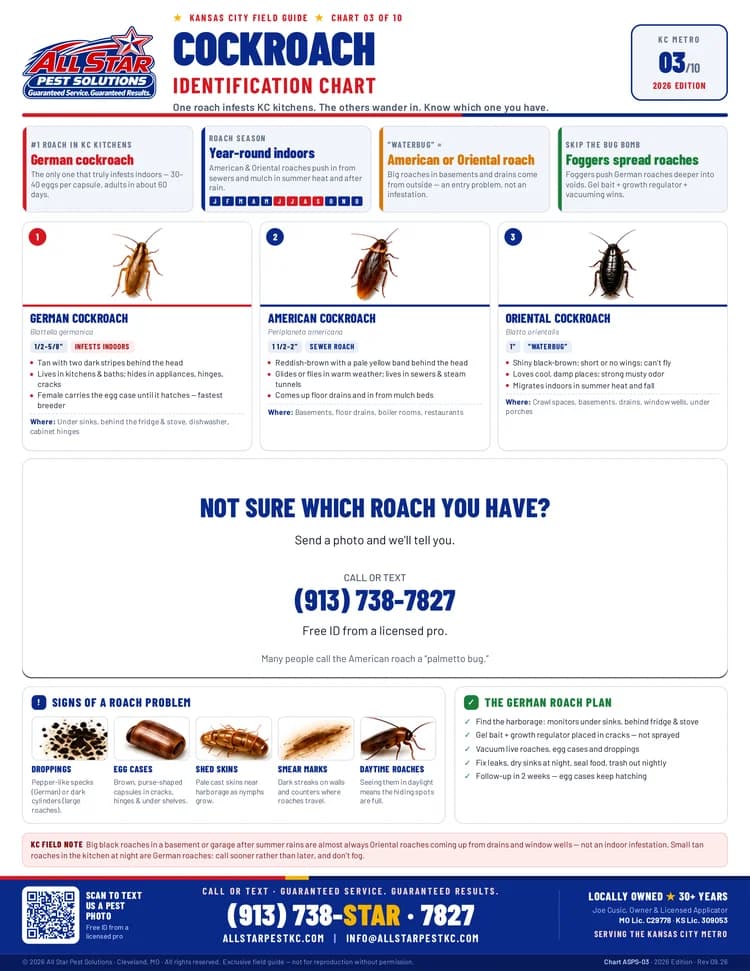
Three cockroaches show up in Kansas City homes, and only one of them truly infests the inside of a house: the German cockroach. American and Oriental roaches — the big ones people call 'waterbugs' — come in from sewers, drains and mulch, especially in summer heat and after rain. That makes them an entry problem, not an indoor infestation.
| Pest | Size | How to identify it | Where you find it |
|---|---|---|---|
| German cockroachBlattella germanica | 1/2–5/8" | Tan with two dark stripes behind the head; the female carries her egg case until it is ready to hatch; 30–40 eggs per capsule and adults in about 60 days — the fastest breeder of the three. | Under sinks, behind the fridge and stove, dishwashers, cabinet hinges |
| American cockroachPeriplaneta americana | 1 1/2–2" | Reddish-brown with a pale yellow band behind the head; glides or flies in warm weather; lives in sewers and steam tunnels; comes up floor drains and in from mulch beds. Often called a 'palmetto bug'. | Basements, floor drains, boiler rooms, restaurants |
| Oriental cockroachBlatta orientalis | 1" | Shiny black-brown; short wings or none and cannot fly; prefers cool, damp places; strong musty odor; migrates indoors in summer heat and fall. The usual 'waterbug'. | Crawl spaces, basements, drains, window wells, under porches |
Signs of a roach problem
- Droppings
- Pepper-like specks (German) or dark cylinders (large roaches).
- Egg cases
- Brown, purse-shaped capsules in cracks, hinges and under shelves.
- Shed skins
- Pale cast skins near hiding spots as nymphs grow.
- Smear marks
- Dark streaks on walls and counters along travel routes.
- Daytime roaches
- Seeing them in daylight usually means the hiding spots are full.
KC field note: Big black roaches in a basement or garage after summer rains are almost always Oriental roaches coming up from drains and window wells — not an indoor infestation. Small tan roaches in the kitchen at night are German roaches: call sooner rather than later, and don't use a fogger, which pushes them deeper into wall voids.
Rodent Identification Chart
Chart 04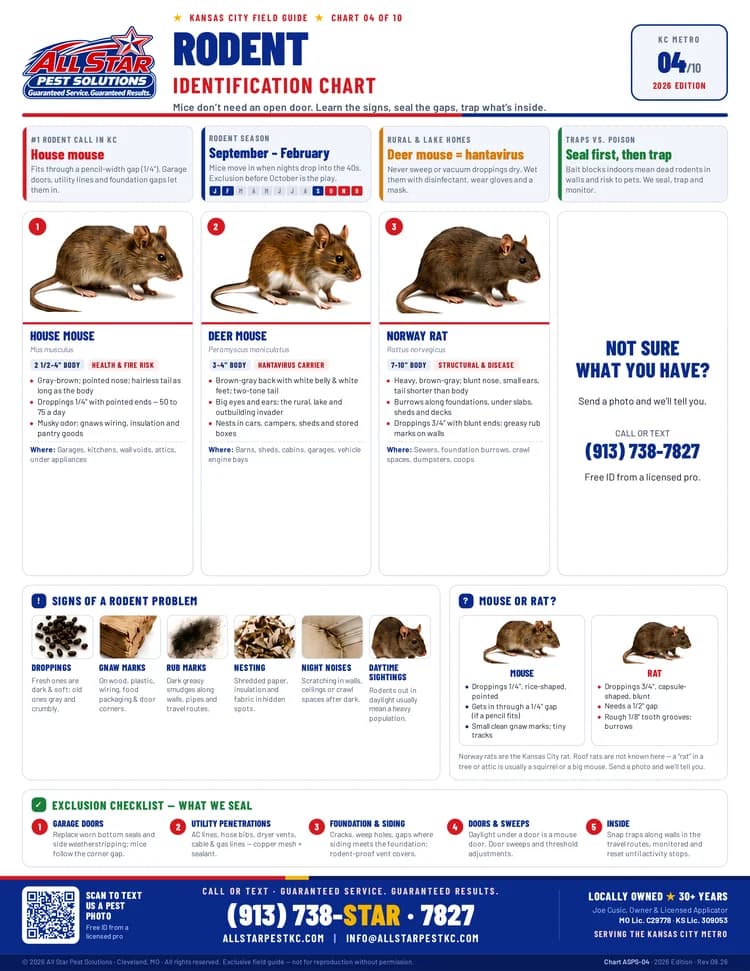
Three rodents get into Kansas City homes: the house mouse, the deer mouse and the Norway rat. Rodent season runs September through February — mice move in when nights drop into the 40s. A house mouse fits through a 1/4-inch gap, about the width of a pencil, so garage doors, utility lines and foundation gaps are the usual ways in.
| Pest | Body length | How to identify it | Where you find it |
|---|---|---|---|
| House mouseMus musculus | 2 1/2–4" | Gray-brown with a pointed nose; hairless tail about as long as the body; droppings 1/4" with pointed ends; musky odor; gnaws wiring, insulation and pantry goods. | Garages, kitchens, wall voids, attics, under appliances |
| Deer mousePeromyscus maniculatus | 3–4" | Brown-gray back with a white belly and white feet; sharply two-tone tail; big eyes and ears. Carries hantavirus — never sweep or vacuum its droppings dry; wet them with disinfectant and wear gloves and a mask. | Barns, sheds, cabins, garages, campers and vehicle engine bays |
| Norway ratRattus norvegicus | 7–10" | Heavy and brown-gray with a blunt nose and small ears; tail shorter than the body; burrows along foundations and under slabs; droppings 3/4" with blunt ends; greasy rub marks on walls. | Sewers, foundation burrows, crawl spaces, dumpsters, coops |
Mouse or rat?
Mouse
- Droppings 1/4", rice-shaped and pointed
- Gets through a 1/4" gap (if a pencil fits)
- Small, clean gnaw marks; tiny tracks
Rat
- Droppings 3/4", capsule-shaped and blunt
- Needs about a 1/2" gap
- Rough 1/8" tooth grooves; burrows
The Norway rat is the Kansas City rat. Roof rats are not known here.
Signs of a rodent problem
- Droppings
- Fresh ones are dark and soft; old ones are gray and crumbly.
- Gnaw marks
- On wood, plastic, wiring, food packaging and door corners.
- Rub marks
- Dark, greasy smudges along walls, pipes and travel routes.
- Nesting
- Shredded paper, insulation and fabric in hidden spots.
- Night noises
- Scratching in walls, ceilings or crawl spaces after dark.
- Daytime sightings
- Rodents out in daylight usually mean a heavy population.
Termite Identification Chart
Chart 05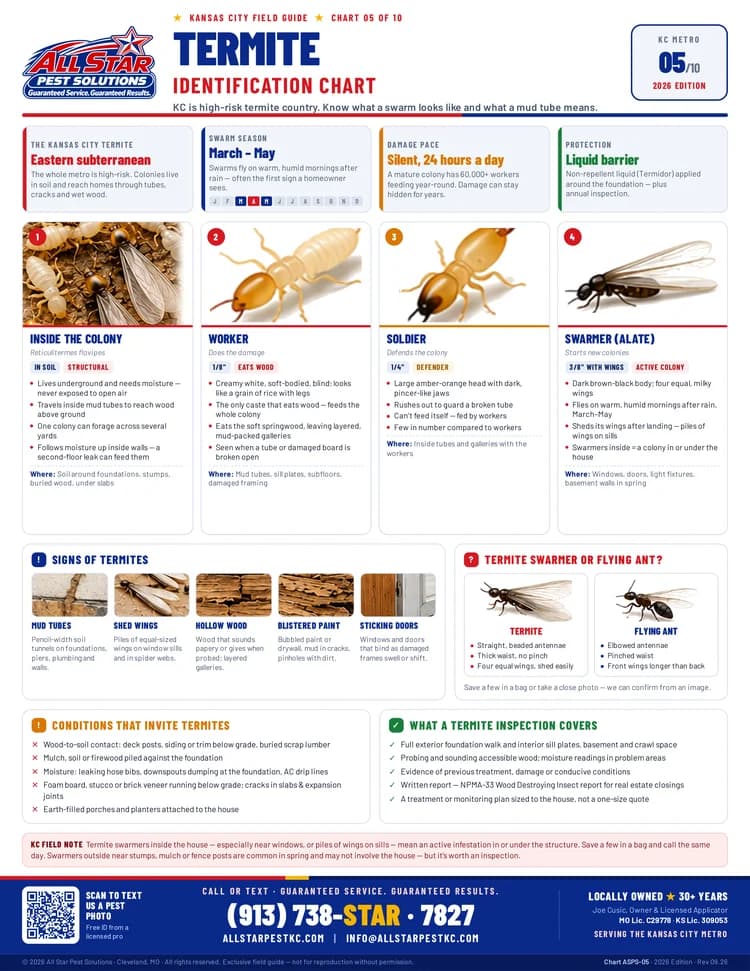
The Kansas City termite is the eastern subterranean termite (Reticulitermes flavipes), and the whole metro is high-risk. Colonies live in the soil and reach homes through mud tubes, cracks and wet wood. Swarm season runs March through May: swarmers fly on warm, humid mornings after rain, and that swarm is often the first sign a homeowner sees. A mature colony can have tens of thousands of workers feeding year-round, so damage can stay hidden for years.
| Pest | Size | How to identify it | Where you find it |
|---|---|---|---|
| ColonyReticulitermes flavipes | — | Lives underground and needs moisture — never exposed to open air; travels inside mud tubes to reach wood above ground; one colony can forage across several yards; follows moisture up inside walls. | Soil around foundations, stumps, buried wood, under slabs |
| Worker | 1/8" | Creamy white, soft-bodied and blind — looks like a grain of rice with legs. The only caste that eats wood; it feeds the whole colony. Eats the soft springwood, leaving layered, mud-packed galleries. | Mud tubes, sill plates, subfloors, damaged framing |
| Soldier | 1/4" | Large amber-orange head with dark, pincer-like jaws; rushes out to guard a broken tube; can't feed itself and is fed by workers; few in number compared to workers. | Inside tubes and galleries with the workers |
| Swarmer (alate) | 3/8" with wings | Dark brown-black body with four equal, milky wings; flies on warm, humid spring mornings after rain; sheds its wings after landing, leaving piles of wings on sills. Swarmers inside mean a colony in or under the house. | Windows, doors, light fixtures, basement walls in spring |
Termite swarmer or flying ant?
Termite swarmer
- Straight, beaded antennae
- Thick waist with no pinch
- Four equal-length wings that shed easily
Flying ant
- Elbowed (bent) antennae
- Pinched, narrow waist
- Front wings longer than the back wings
Save a few in a bag or take a close photo — we can confirm the ID from an image.
Signs of termites
- Mud tubes
- Pencil-width soil tunnels on foundations, piers, plumbing and walls.
- Shed wings
- Piles of equal-sized wings on window sills and in spider webs.
- Hollow wood
- Wood that sounds papery or gives when probed; layered galleries.
- Blistered paint
- Bubbled paint or drywall, mud in cracks, pinholes with dirt.
- Sticking doors
- Windows and doors that bind as damaged frames swell or shift.
KC field note: Conditions that invite termites: wood-to-soil contact (deck posts, siding or trim below grade, buried scrap lumber); mulch, soil or firewood piled against the foundation; moisture from leaking hose bibs, downspouts and AC drip lines; foam board, stucco or brick veneer running below grade; cracks in slabs and expansion joints; and earth-filled porches and planters attached to the house. Swarmers outside near stumps, mulch or fence posts are common in spring and may not involve the house — but swarmers inside, or piles of wings on sills, mean an active infestation in or under the structure.
Tick Identification Chart
Chart 06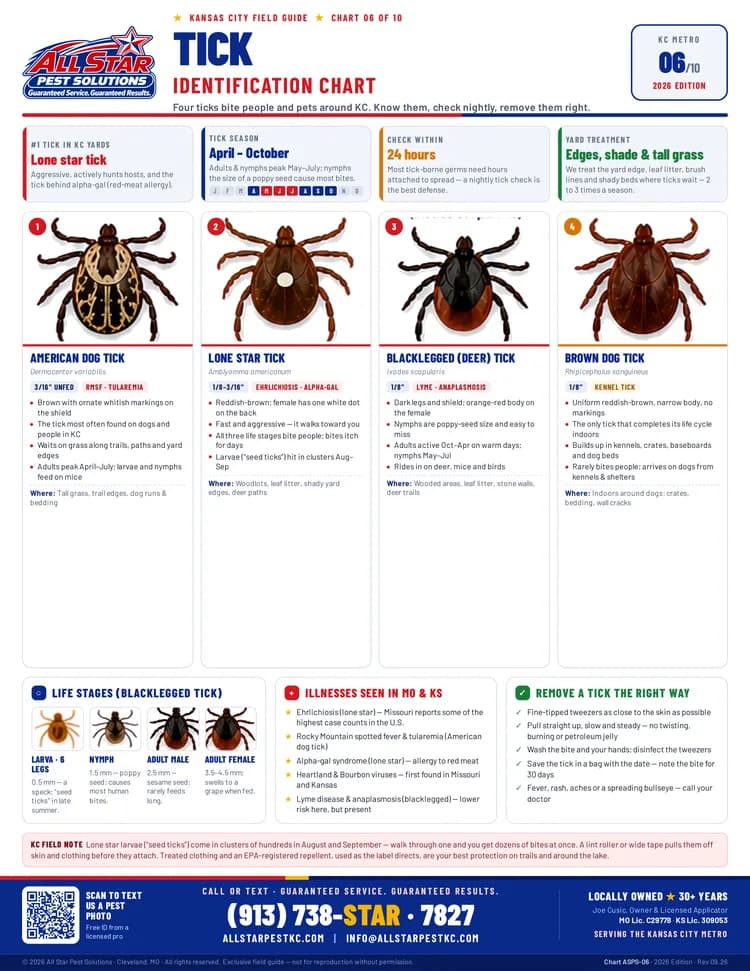
Four ticks bite people and pets around Kansas City. Tick season runs April through October, with adults and nymphs peaking May through July; nymphs the size of a poppy seed cause most bites. The lone star tick is the most common tick in Kansas City yards. Most tick-borne germs need hours of attachment to spread, so a nightly tick check is the best defense.
| Pest | Size | How to identify it | Where you find it |
|---|---|---|---|
| American dog tickDermacentor variabilis | 3/16" unfed | Brown with ornate whitish markings on the shield; the tick most often found on dogs and people in KC; waits on grass along trails, paths and yard edges; adults peak April–July. Associated with Rocky Mountain spotted fever and tularemia. | Tall grass, trail edges, dog runs and bedding |
| Lone star tickAmblyomma americanum | 1/8–3/16" | Reddish-brown; the female has one white dot on her back; fast and aggressive, it walks toward you; all three life stages bite people; larvae ('seed ticks') hit in clusters August–September. Associated with ehrlichiosis and alpha-gal syndrome (red-meat allergy). | Woodlots, leaf litter, shady yard edges, deer paths |
| Blacklegged (deer) tickIxodes scapularis | 1/8" | Dark legs and shield; orange-red body on the female; nymphs are poppy-seed size and easy to miss; adults active October–April on warm days, nymphs May–July. Associated with Lyme disease and anaplasmosis — lower risk here, but present. | Wooded areas, leaf litter, stone walls, deer trails |
| Brown dog tickRhipicephalus sanguineus | 1/8" | Uniform reddish-brown with a narrow body and no markings; the only tick that completes its life cycle indoors; builds up in kennels, crates, baseboards and dog beds; rarely bites people. | Indoors around dogs: crates, bedding, wall cracks |
Life stages (blacklegged tick)
- Larva
- Six legs; about 0.5 mm — a speck. These are the 'seed ticks' of late summer.
- Nymph
- About 1.5 mm, poppy-seed size; causes most human bites.
- Adult male
- About 2.5 mm, sesame-seed size; rarely feeds long.
- Adult female
- 3.5–4.5 mm; swells to the size of a grape when fed.
KC field note: Removing a tick: use fine-tipped tweezers as close to the skin as possible and pull straight up, slow and steady — no twisting, burning or petroleum jelly. Wash the bite and your hands and disinfect the tweezers. Save the tick in a bag with the date and note the bite for 30 days. Fever, rash, aches or a spreading bullseye — call your doctor. Heartland and Bourbon viruses were first found in Missouri and Kansas.
Bee & Wasp Identification Chart
Chart 07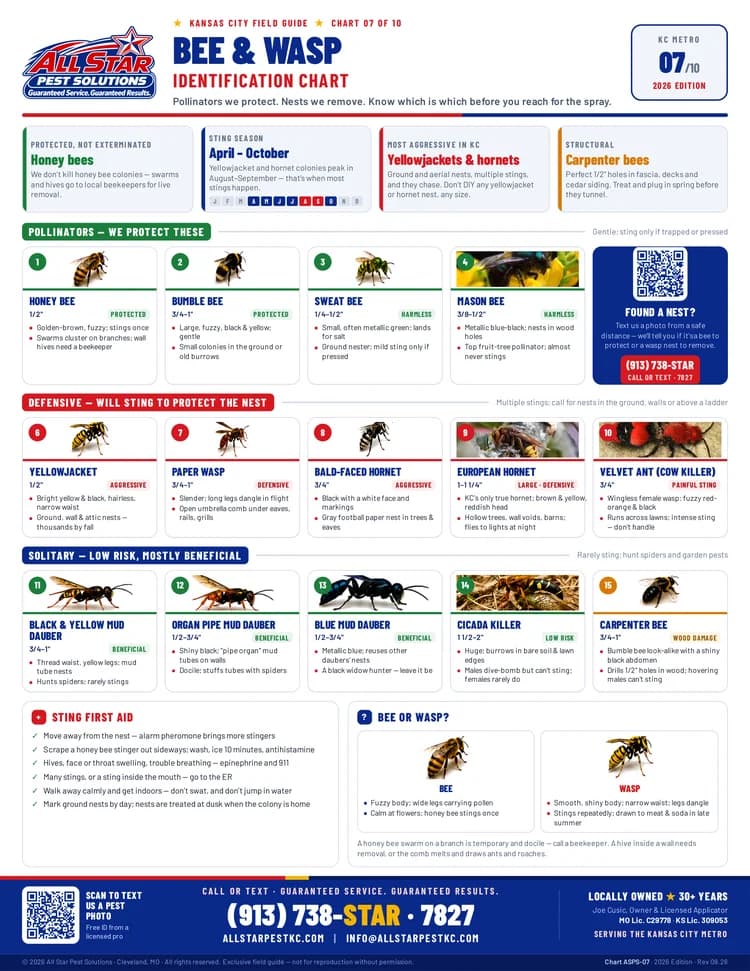
Fourteen bees and wasps common around Kansas City, sorted into three groups: pollinators that are gentle and sting only if trapped or pressed; defensive wasps that will sting to protect the nest; and solitary wasps that rarely sting and mostly hunt spiders and garden pests. Sting season runs April through October, and yellowjacket and hornet colonies peak in August and September — that's when most stings happen.
| Pest | Size | How to identify it | Where you find it |
|---|---|---|---|
| Honey bee (pollinator) | 1/2" | Golden-brown and fuzzy; stings once; swarms cluster on branches. | Swarms on branches; hives in wall voids |
| Bumble bee (pollinator) | 3/4–1" | Large, fuzzy, black and yellow; gentle. | Small colonies in the ground or old burrows |
| Sweat bee (pollinator) | 1/4–1/2" | Small, often metallic green; lands on skin for salt; mild sting only if pressed. | Ground nests |
| Mason bee (pollinator) | 3/8–1/2" | Metallic blue-black; top fruit-tree pollinator; almost never stings. | Holes in wood |
| Yellowjacket (defensive) | 1/2" | Bright yellow and black, hairless, narrow waist; nests reach thousands of workers by fall; multiple stings. | Ground, wall and attic nests |
| Paper wasp (defensive) | 3/4–1" | Slender, with long legs that dangle in flight; open umbrella-shaped comb. | Under eaves, rails and grills |
| Bald-faced hornet (defensive) | 3/4" | Black with a white face and markings; gray, football-shaped paper nest. | Trees and eaves |
| European hornet (defensive) | 1–1 1/4" | Kansas City's only true hornet; brown and yellow with a reddish head; flies to lights at night. | Hollow trees, wall voids, barns |
| Velvet ant / cow killer | 3/4" | Wingless female wasp, fuzzy red-orange and black; runs across lawns; intense sting — don't handle. | Lawns and bare ground |
| Black & yellow mud dauber (solitary) | 3/4–1" | Thread waist and yellow legs; builds mud tube nests; hunts spiders; rarely stings. | Walls, eaves, sheltered corners |
| Organ pipe mud dauber (solitary) | 1/2–3/4" | Shiny black; builds 'pipe organ' mud tubes on walls; docile; stocks tubes with spiders. | Walls and eaves |
| Blue mud dauber (solitary) | 1/2–3/4" | Metallic blue; reuses other daubers' nests; a black widow hunter. | Old mud dauber nests |
| Cicada killer (solitary) | 1 1/2–2" | Huge; burrows in bare soil and lawn edges; males dive-bomb but can't sting; females rarely do. | Bare soil, lawn edges |
| Carpenter bee | 3/4–1" | Bumble bee look-alike with a shiny black abdomen; drills perfect 1/2" holes in wood; the hovering males can't sting. | Fascia, decks, cedar siding |
Bee or wasp?
Bee
- Fuzzy body; wide legs carrying pollen
- Calm at flowers; a honey bee stings once
Wasp
- Smooth, shiny body; narrow waist; legs dangle
- Can sting repeatedly; drawn to meat and soda in late summer
A honey bee swarm on a branch is temporary and docile — call a beekeeper. A hive inside a wall needs removal, or the comb melts and draws ants and roaches.
KC field note: Sting first aid from the chart: move away from the nest, since alarm pheromone brings more stingers. Scrape a honey bee stinger out sideways, wash, and ice for 10 minutes. Hives, face or throat swelling or trouble breathing — use epinephrine and call 911. Many stings, or a sting inside the mouth — go to the ER. Walk away calmly and get indoors; don't swat and don't jump in water.
Beneficial Insects Chart
Chart 08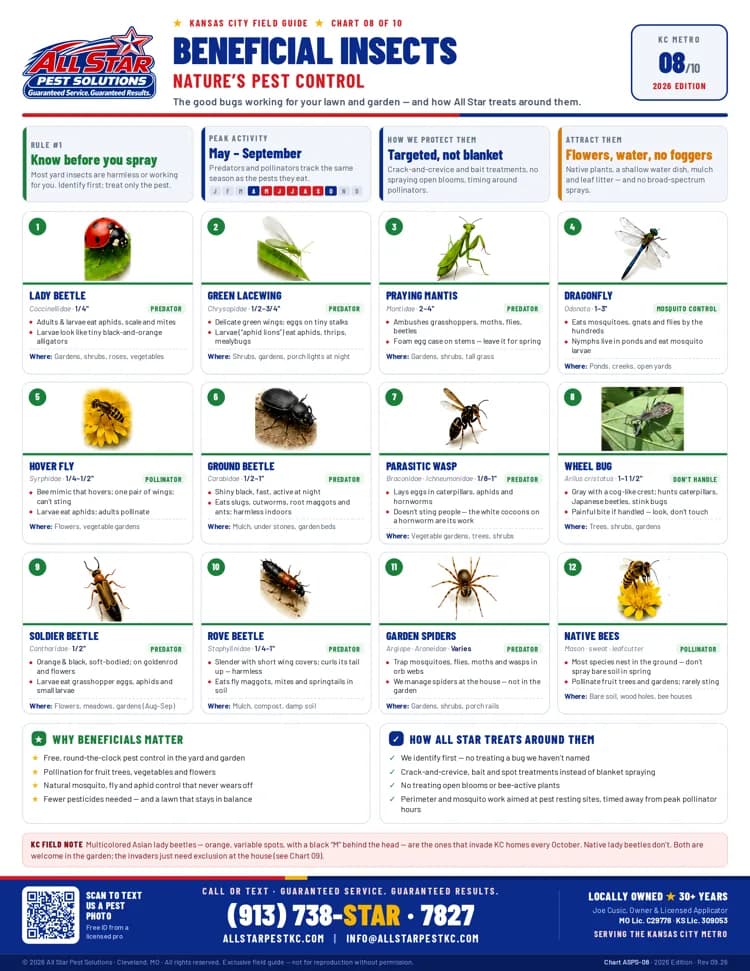
Most insects in a Kansas City yard are harmless or working for you. These twelve predators and pollinators are most active May through September — the same season as the pests they eat. Identify first and treat only the pest.
| Pest | Size | How to identify it | Where you find it |
|---|---|---|---|
| Lady beetleCoccinellidae | 1/4" | Adults and larvae eat aphids, scale and mites; larvae look like tiny black-and-orange alligators. | Gardens, shrubs, roses, vegetables |
| Green lacewingChrysopidae | 1/2–3/4" | Delicate green wings; eggs laid on tiny stalks; larvae ('aphid lions') eat aphids, thrips and mealybugs. | Shrubs, gardens, porch lights at night |
| Praying mantisMantidae | 2–4" | Ambushes grasshoppers, moths, flies and beetles; foam egg case on stems — leave it for spring. | Gardens, shrubs, tall grass |
| DragonflyOdonata | 1–3" | Eats mosquitoes, gnats and flies; nymphs live in ponds and eat mosquito larvae. | Ponds, creeks, open yards |
| Hover flySyrphidae | 1/4–1/2" | Bee mimic that hovers; one pair of wings and can't sting; larvae eat aphids, adults pollinate. | Flowers, vegetable gardens |
| Ground beetleCarabidae | 1/2–1" | Shiny black, fast and active at night; eats slugs, cutworms, root maggots and ants; harmless indoors. | Mulch, under stones, garden beds |
| Parasitic waspBraconidae, Ichneumonidae | 1/8–1" | Lays eggs in caterpillars, aphids and hornworms; doesn't sting people. White cocoons on a hornworm are its work. | Vegetable gardens, trees, shrubs |
| Wheel bugArilus cristatus | 1–1 1/2" | Gray with a cog-like crest on its back; hunts caterpillars, Japanese beetles and stink bugs; painful bite if handled — look, don't touch. | Trees, shrubs, gardens |
| Soldier beetleCantharidae | 1/2" | Orange and black, soft-bodied, often on goldenrod; larvae eat grasshopper eggs, aphids and small larvae. | Flowers, meadows, gardens (August–September) |
| Rove beetleStaphylinidae | 1/4–1" | Slender with short wing covers; curls its tail up but is harmless; eats fly maggots, mites and springtails in soil. | Mulch, compost, damp soil |
| Garden spidersArgiope, Araneidae | — | Trap mosquitoes, flies, moths and wasps in orb webs. | Gardens, shrubs, porch rails |
| Native beesMason, sweat, leafcutter | — | Most species nest in the ground; pollinate fruit trees and gardens; rarely sting. | Bare soil, wood holes, bee houses |
KC field note: Multicolored Asian lady beetles — orange, with variable spots and a black 'M' behind the head — are the ones that invade Kansas City homes every October. Native lady beetles don't. Both are welcome in the garden; the invaders just need to be kept out of the house (see the occasional invader chart).
Occasional Invader Identification Chart
Chart 09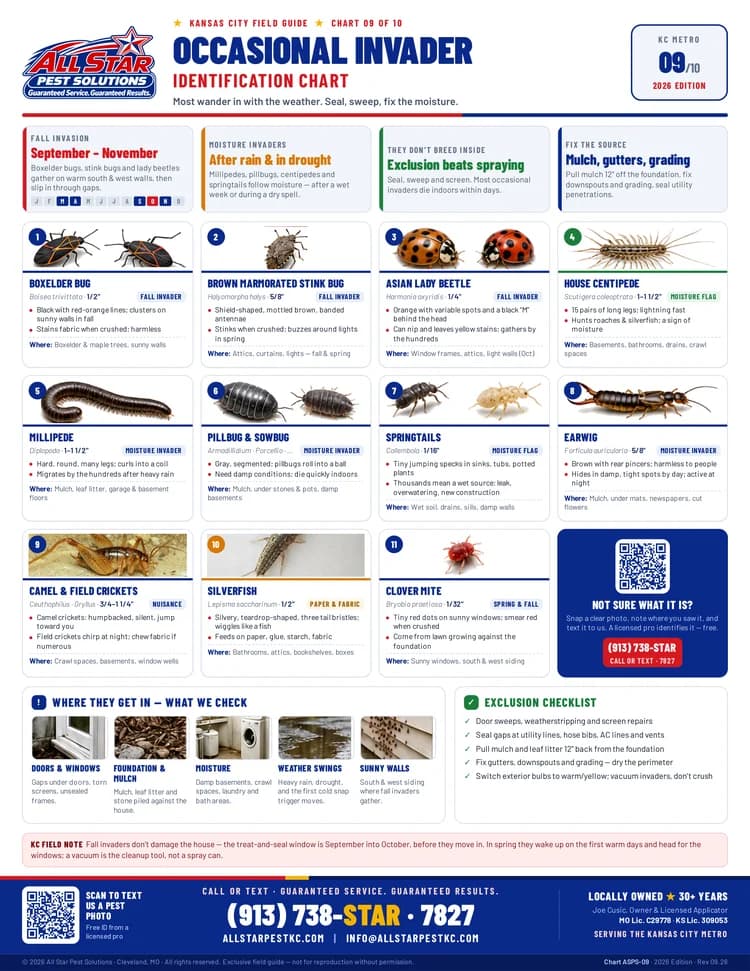
Occasional invaders live outdoors and wander in with the weather. Boxelder bugs, stink bugs and Asian lady beetles gather on warm south and west walls from September through November, then slip in through gaps. Millipedes, pillbugs, centipedes and springtails follow moisture — after a wet week or during a dry spell. They don't breed inside, and most die indoors within days.
| Pest | Size | How to identify it | Where you find it |
|---|---|---|---|
| Boxelder bugBoisea trivittata | 1/2" | Black with red-orange lines; clusters on sunny walls in fall; stains fabric when crushed; harmless. | Boxelder and maple trees, sunny walls |
| Brown marmorated stink bugHalyomorpha halys | 5/8" | Shield-shaped, mottled brown, banded antennae; stinks when crushed; buzzes around lights in spring. | Attics, curtains, lights — fall and spring |
| Asian lady beetleHarmonia axyridis | 1/4" | Orange with variable spots and a black 'M' behind the head; can nip and leaves yellow stains; gathers by the hundreds. | Window frames, attics, light-colored walls (October) |
| House centipedeScutigera coleoptrata | 1–1 1/2" | Fifteen pairs of long legs; lightning fast; hunts roaches and silverfish; a sign of moisture. | Basements, bathrooms, drains, crawl spaces |
| MillipedeDiplopoda | 1–1 1/2" | Hard, round and many-legged; curls into a coil; migrates by the hundreds after heavy rain. | Mulch, leaf litter, garage and basement floors |
| Pillbug & sowbugArmadillidium, Porcellio | — | Gray and segmented; pillbugs roll into a ball; need damp conditions and die quickly indoors. | Mulch, under stones and pots, damp basements |
| SpringtailsCollembola | 1/16" | Tiny jumping specks in sinks, tubs and potted plants; thousands mean a wet source — a leak, overwatering or new construction. | Wet soil, drains, sills, damp walls |
| EarwigForficula auricularia | 5/8" | Brown with rear pincers; harmless to people; hides in damp, tight spots by day and is active at night. | Mulch, under mats, newspapers, cut flowers |
| Camel & field cricketsCeuthophilus, Gryllus | 3/4–1 1/4" | Camel crickets are humpbacked and silent and jump toward you; field crickets chirp at night and can chew fabric if numerous. | Crawl spaces, basements, window wells |
| SilverfishLepisma saccharinum | 1/2" | Silvery and teardrop-shaped with three tail bristles; wiggles like a fish; feeds on paper, glue, starch and fabric. | Bathrooms, attics, bookshelves, boxes |
| Clover miteBryobia praetiosa | 1/32" | Tiny red dots on sunny windows; smears red when crushed; comes from lawn growing against the foundation. Active spring and fall. | Sunny windows, south and west siding |
Where they get in
- Doors & windows
- Gaps under doors, torn screens, unsealed frames.
- Foundation & mulch
- Mulch, leaf litter and stone piled against the house.
- Moisture
- Damp basements, crawl spaces, laundry and bath areas.
- Weather swings
- Heavy rain, drought and the first cold snap trigger moves.
- Sunny walls
- South and west siding where fall invaders gather.
KC field note: Fall invaders don't damage the house. In spring they wake up on the first warm days and head for the windows; a vacuum is the cleanup tool. The chart's exclusion checklist: door sweeps, weatherstripping and screen repairs; seal gaps at utility lines, hose bibs, AC lines and vents; pull mulch and leaf litter 12 inches back from the foundation; fix gutters, downspouts and grading to dry the perimeter; switch exterior bulbs to warm/yellow; and vacuum invaders rather than crushing them.
Household Pest Identification Chart
Chart 10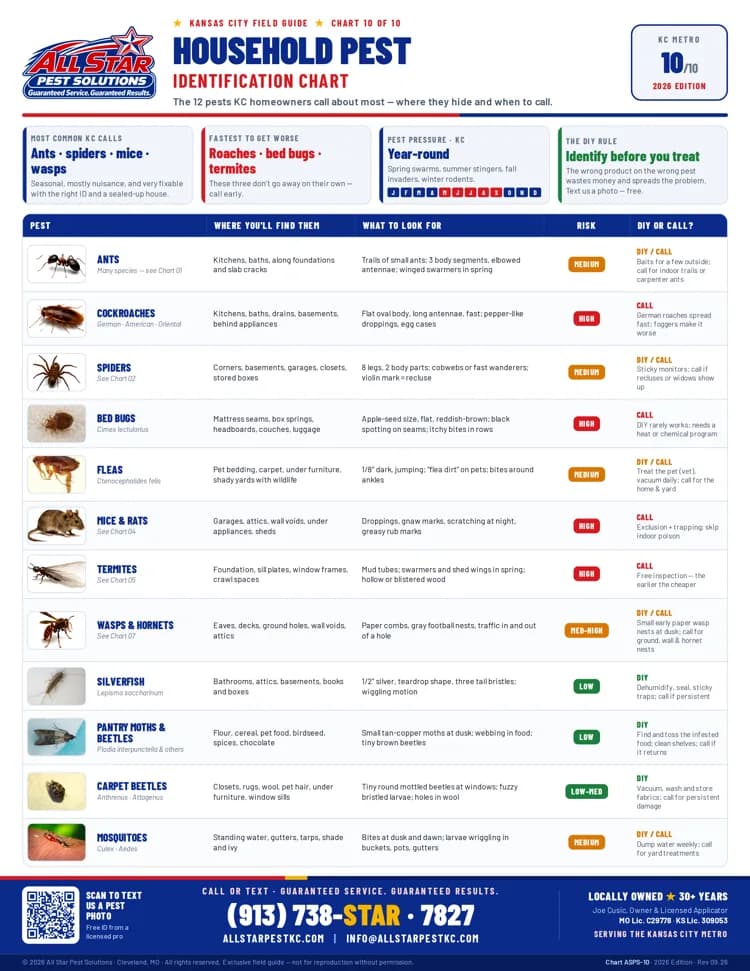


The twelve pests Kansas City homeowners ask about most, with where each one hides and what to look for. Ants, spiders, mice and wasps are the most common calls — seasonal, mostly nuisance, and very fixable with the right ID and a sealed-up house. Roaches, bed bugs and termites get worse fastest and don't go away on their own. Pest pressure in KC is year-round: spring swarms, summer stingers, fall invaders and winter rodents.
| Pest | Risk | How to identify it | Where you find it |
|---|---|---|---|
| Ants | Medium | Trails of small ants; three body segments; elbowed antennae; winged swarmers in spring. | Kitchens, baths, along foundations and slab cracks |
| Cockroaches | High | Flat oval body, long antennae, fast; pepper-like droppings; egg cases. | Kitchens, baths, drains, basements, behind appliances |
| Spiders | Medium | Eight legs, two body parts; cobwebs or fast wanderers; a violin mark means brown recluse. | Corners, basements, garages, closets, stored boxes |
| Bed bugsCimex lectularius | High | Apple-seed size, flat, reddish-brown; black spotting on seams; itchy bites in rows. | Mattress seams, box springs, headboards, couches, luggage |
| FleasCtenocephalides felis | Medium | 1/8", dark and jumping; "flea dirt" on pets; bites around ankles. | Pet bedding, carpet, under furniture, shady yards |
| Mice & rats | High | Droppings, gnaw marks, scratching at night, greasy rub marks. | Garages, attics, wall voids, under appliances, sheds |
| Termites | High | Mud tubes; swarmers and shed wings in spring; hollow or blistered wood. | Foundation, sill plates, window frames, crawl spaces |
| Wasps & hornets | Medium-high | Paper combs, gray football-shaped nests, traffic in and out of a hole. | Eaves, decks, ground holes, wall voids, attics |
| SilverfishLepisma saccharinum | Low | 1/2", silver, teardrop shape, three tail bristles; wiggling motion. | Bathrooms, attics, basements, books and boxes |
| Pantry moths & beetlesPlodia interpunctella and others | Low | Small tan-copper moths at dusk; webbing in food; tiny brown beetles. | Flour, cereal, pet food, birdseed, spices, chocolate |
| Carpet beetlesAnthrenus, Attagenus | Low-medium | Tiny round mottled beetles at windows; fuzzy bristled larvae; holes in wool. | Closets, rugs, wool, pet hair, under furniture, window sills |
| MosquitoesCulex, Aedes | Medium | Bites at dusk and dawn; larvae wriggling in buckets, pots and gutters. | Standing water, gutters, tarps, shade and ivy |
Pest Identification Questions
How do I tell a termite swarmer from a flying ant?+
Look at three things. A termite swarmer has straight, beaded antennae, a thick waist with no pinch, and four wings of equal length that break off easily. A flying ant has elbowed (bent) antennae, a pinched, narrow waist, and front wings that are longer than its back wings. Both swarm in Kansas City in spring. Termite swarmers inside the house, or piles of shed wings on window sills, mean an active colony in or under the structure.
When do termites swarm in Kansas City?+
Eastern subterranean termites, the termite found across the Kansas City metro, swarm from March through May. Swarmers fly on warm, humid mornings, usually after a rain, and the swarm is often the first sign a homeowner sees.
What does a termite look like?+
It depends on the caste. Workers are about 1/8 inch, creamy white, soft-bodied and blind — like a grain of rice with legs — and they are the ones that eat wood. Soldiers are about 1/4 inch with a large amber-orange head and dark, pincer-like jaws. Swarmers are about 3/8 inch with wings, with a dark brown-black body and four equal, milky wings.
How can I tell a brown recluse from a look-alike spider?+
A brown recluse has six eyes in three pairs, a dark violin mark on the back, plain tan-brown legs with no bands, spines or stripes, a one-color abdomen, and a body only 1/4 to 1/2 inch long. Wolf, grass and house spiders have eight eyes, and usually striped or banded legs, visible spines or a patterned abdomen.
How do I tell mouse droppings from rat droppings?+
House mouse droppings are about 1/4 inch long, rice-shaped, with pointed ends. Norway rat droppings are about 3/4 inch, capsule-shaped, with blunt ends. Fresh droppings are dark and soft; old ones are gray and crumbly. Never sweep or vacuum droppings dry, especially in sheds and cabins where deer mice live — wet them with disinfectant and wear gloves and a mask.
Are these pest identification charts free to download?+
Yes. All ten Kansas City Field Guide charts are free as a letter-size PDF and a high-resolution PNG. If you can't match what you found, text a clear photo to (913) 738-7827 and a licensed pro will identify it for free.
Not sure what you are looking at?
Text a clear photo to (913) 738-7827. A licensed pro identifies it — free.
Locally owned · 30+ years in pest control · MO Lic. C29778 · KS Lic. 309053