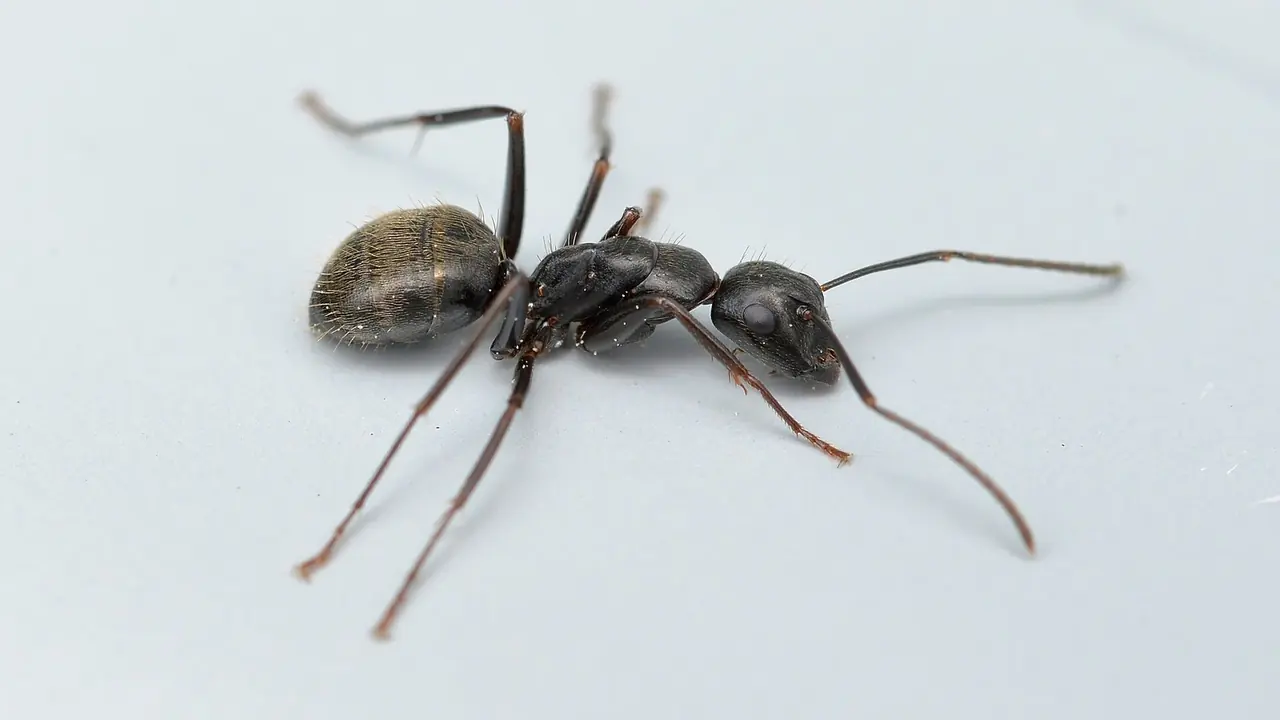
Photo: Ryan Hodnett, CC BY-SA 4.0, via Wikimedia Commons
Kansas City Pest Identification
Camponotus pennsylvanicus and related speciesCarpenter Ant Identification
Our largest ant, and the one that matters structurally. Carpenter ants do not eat wood — they excavate it to nest in, most often moisture-damaged or decayed wood, though satellite colonies can also turn up in drier wall voids and sound wood. The damage is regularly mistaken for termites.
Need help identifying carpenter ant?
Text a photo for fast pest identification. You'll get a real answer from a local expert — not a call center.
How to Identify It
Big black (sometimes red-and-black) ants with a smoothly rounded thorax when viewed from the side and a single-node waist. Workers come in different sizes in the same colony. Piles of fine, sawdust-like frass with insect parts in it near baseboards, window frames, or sill plates point to an active nest.
Size: Workers 6–13 mm; queens to 20 mm
Commonly Confused With
Termite swarmers vs. carpenter ant swarmers: ants have elbowed antennae, a pinched waist, and front wings longer than the back wings; termites have straight antennae, a thick waist, and equal-length wings. Carpenter ant galleries are smooth and clean; termite galleries are packed with mud.
Why It Shows Up
Most often moisture-damaged or decayed wood — leaking window frames, roof edges, deck ledgers, wood-to-soil contact, and bathrooms with a slow leak. The main colony is usually outdoors in a stump or tree; a satellite nest moves into the house. Satellite colonies can also establish in drier wall voids and sound wood, so a moisture problem isn't a given just because ants are present.
Where Homeowners Find It
Around windows and doors, under bathroom and kitchen sinks, in attic insulation, along roof eaves, and in hollow porch columns. You may hear a faint rustling in a wall at night.
Seasonal Activity in KC
Foraging from April through October; winged swarmers appear indoors in late winter and spring, which usually means a nest is inside the structure.
Risk Level
Structural. Left alone for years a carpenter ant nest can weaken sill plates, door frames, and deck framing. They also signal a moisture problem that will invite termites if it isn't fixed.
What You Can Do Yourself
- • Check for a moisture source and fix it if you find one — that resolves the most common cause.
- • Trim branches touching the roof or siding; they are the highway in.
- • Note where you see frass or large ants at night with a flashlight; that helps locate the nest.
What Professional Treatment Involves
Locating the parent and satellite nests, then treating the voids directly (dust or foam into the gallery) and a non-repellent perimeter treatment so foragers carry it back. Baits alone are unreliable for carpenter ants. A written moisture-repair recommendation comes with it.
The All Star difference: Because carpenter ant damage looks like termite damage, we inspect and diagnose before quoting anything. If it is ants, you get an ant treatment — not a termite treatment you don't need.
Serving the Kansas City metro area-wide. Owner-operated with 30+ years of professional pest control experience. See our carpenter ant control service →
Common Questions
How do I tell a carpenter ant from something that looks similar?
Termite swarmers vs. carpenter ant swarmers: ants have elbowed antennae, a pinched waist, and front wings longer than the back wings; termites have straight antennae, a thick waist, and equal-length wings. Carpenter ant galleries are smooth and clean; termite galleries are packed with mud.
Do I need professional treatment for carpenter ant?
Locating the parent and satellite nests, then treating the voids directly (dust or foam into the gallery) and a non-repellent perimeter treatment so foragers carry it back. Baits alone are unreliable for carpenter ants. A written moisture-repair recommendation comes with it.